
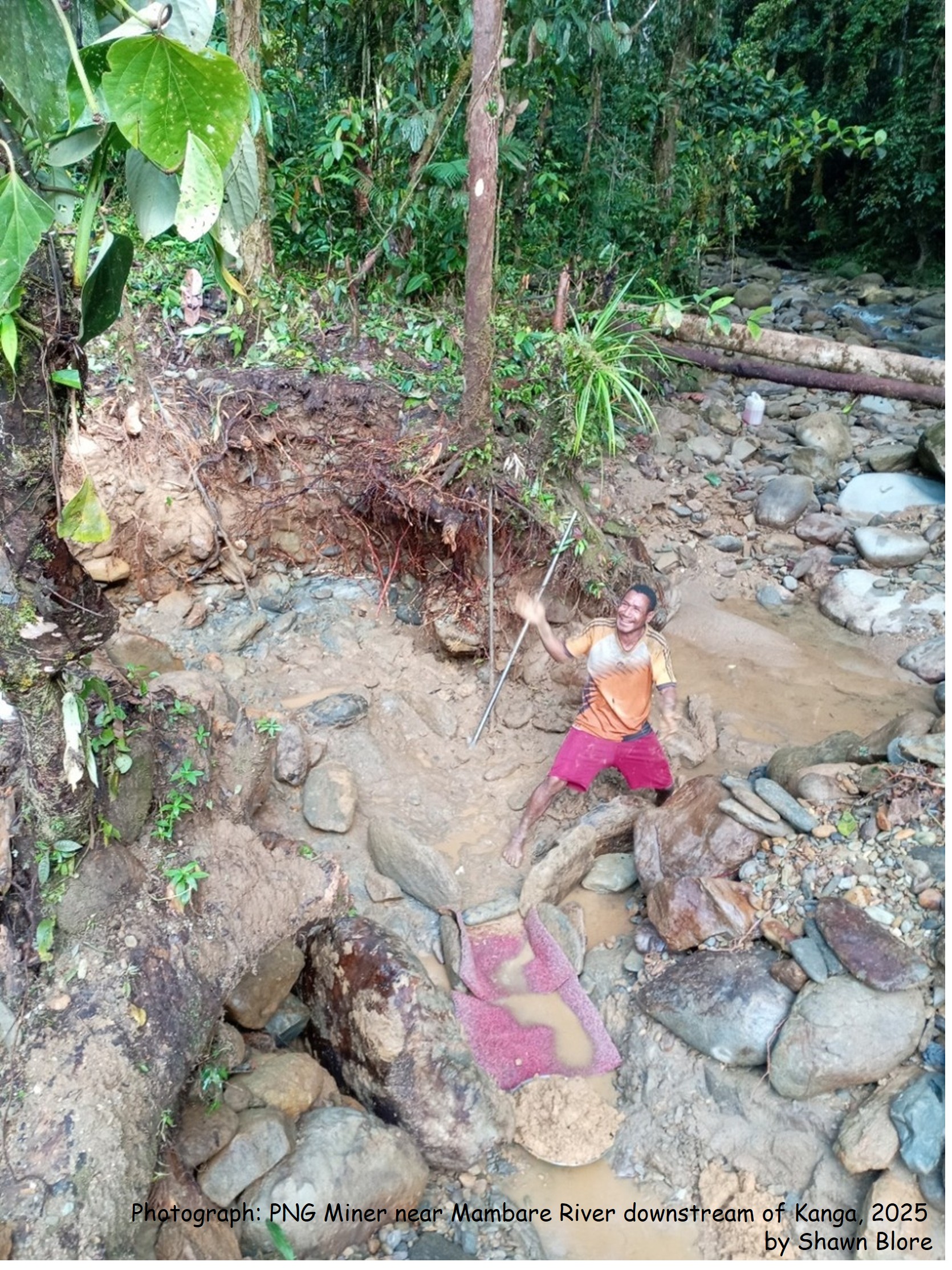
Searching for Gold in the Jungle
The un-tracked interior of Papua New Guinea (PNG) harbours new and as-yet-undiscovered gold fields. Recently I returned from an expedition to one of these new gold finds, in Oro Province on the north coast of PNG’s main island.
Artisanal Gold Enterprises’s mission is to bring an ever-increasing supply of responsible artisanal gold into the formal supply chain as its primary mechanism to improve and professionalize the ASM sector. We do this through an engage-to-improve strategy that complies with the OECD’s progressive due diligence-based guidance. The mission takes us to some far-off places.
Reaching these new gold fields required a a full day’s trek through the rainforest. The mine sites lie along the Mambare River, starting from the village of Kanga and extending several scores of kilometres down the river. Miners, most of them from Kanga or other local villages, don’t work the main river itself, but the small creeks flowing down from the mountains.
Exploitation is still very basic. In a typical set-up a team of 3 or 4 miners use a 2 inch-pump to wash ore from the riverbank down over about 3 feet of rough sluice carpet set into a “ground sluice” – essentially a little channel cut into the mud. After a day of washing, the team pans down the material captured in the carpet and comes up with from 3-5 grams of 70% pure gold; about $300-$500 at current prices and about a gram per person.
Recovery rates are pretty low; the ground-sluice-short-carpet system loses much of the fine gold and a fair portion of the coarse, but grades are good enough here and the gold price high enough that it’s still all worth while.
There is, of course, an environmental price. Environmentalists and Guardian readers looking at such scenes of basic artisanal mining tend to come away horrified, to a degree that is arguably out of proportion with the scale of the actual impact. In part, I think this is because photos of artisanal mining are simply not pretty. But ironically, I think it’s also because the impact is actually quite limited. Looking at these scenes, it’s easy to see and imagine the original landscape – the forest primeval is all its glory – before the grubby hand of man reached in to snatch away the gold.
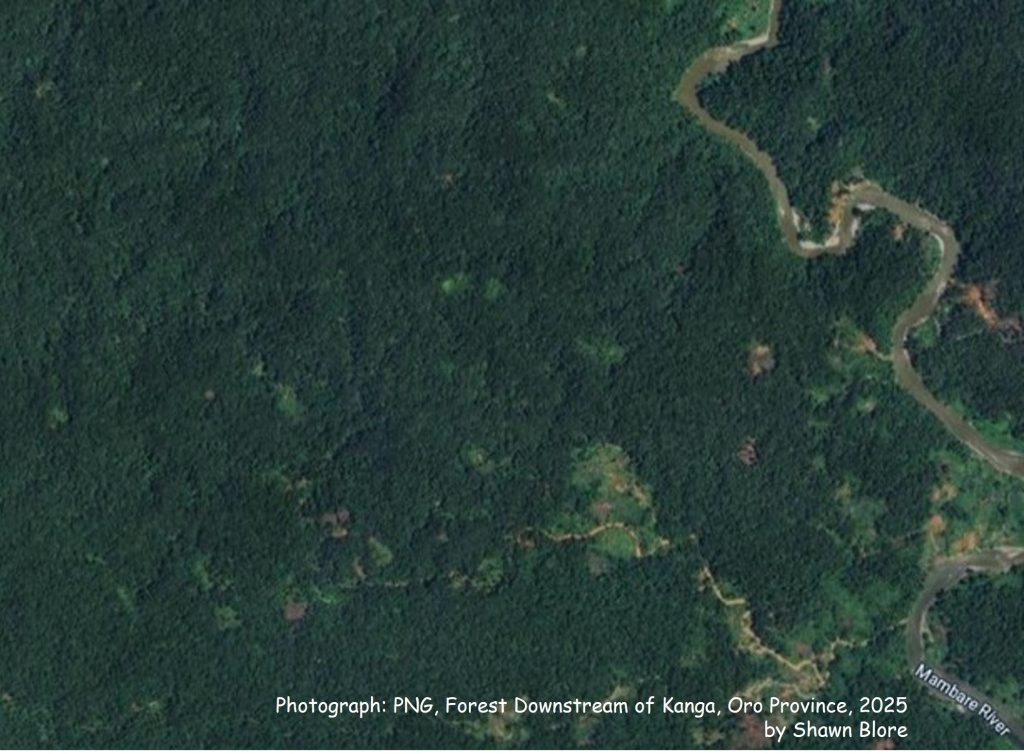
Zoom out to a higher-level view – here courtesy of Google – and it’s hard to even see the mining. The forest appears largely intact – as in fact it is.
Now compare that to the other model of development available to the people of Kanga – a palm-oil plantation located just upstream of Kanga, covering a vastly larger area than the artisanal mining sites.
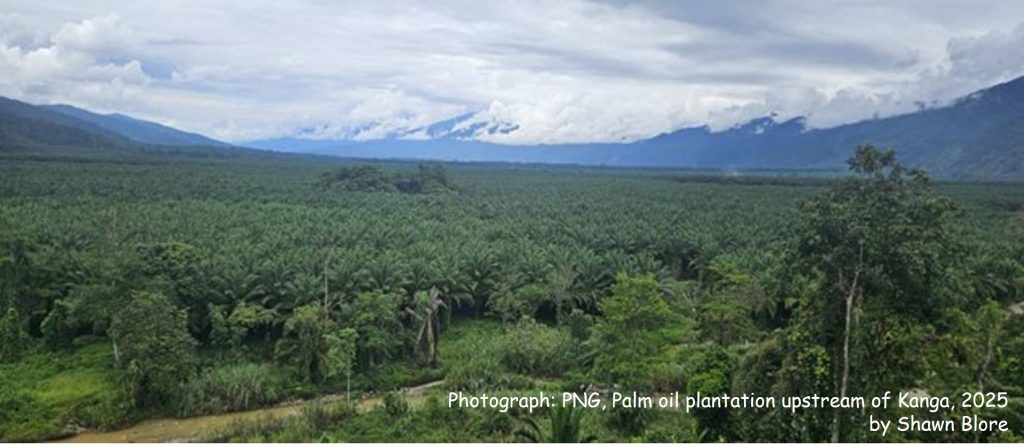
Looked at one way – the way most casual viewers see it – it’s a bucolic scene of ripening tropical palms. No photo editor in his right mind would attach such a scene to a headline. And yet, viewed another way, the planation is a scene of complete environmental apocalypse – the original forest ripped out and so thoroughly replaced by a new commercial landscape that’s it impossible even to imagine what the natural landscape might have looked like, where its animals might have wandered or its creeks and streams might have flowed.
Visuals from one set of landscape impacts generates horror, while the other results in admiration or indifference, in perfect inverse proportion to the actual degree of impact. Perhaps this is simply because after 10,000 years or so of exposure, humans tend to see agricultural landscapes as natural, in a way that mining landscapes do not. Or perhaps its because the transformation to the landscape inherent in agriculture is so total that no other option can be imagined or recalled, and so ironically, the agricultural landscape gets a pass.
To their credit, the people of Kanga – the traditional landowners of this bit of forest – seem for the moment to prefer the mining option. While some residents of Kanga chose to work in the plantation, more seem to prefer mining. In part that’s because mining pays better than plantation work, but perhaps it’s also because with mining, the bulk of the forest remains as it was, still there to provide wood and bamboo and meat and all the other services the people of Kanga here have traditionally relied upon.
As to how Artisanal Gold Enterprise might work with these villagers, that’s still under consideration. Initial ideas include a simple plywood-and-metal-grating upgrade to the ground sluice, with a flatter surface for evenly spread and consistent water flow, and longer outrun to catch some of the fines. Then perhaps a centralized mercury-free concentrate processing plant based on the AGE’s Helicoid Concentrator technology, to speed processing, increase recovery by capturing finer grain sizes and eliminating the use of mercury.
If the numbers and logistics can be made to work, the forests on the banks of the Mambare river would see a little less impact, the miners of Kanga would get more gold for the same effort, and AGE would bring another source of artisanal gold directly to the world’s Good Delivery refiners.